Knowing how to read a pet food label is the single most useful skill a pet parent can develop. The front of any pack is marketing. The back is the truth. Two minutes reading the back will tell you more than any influencer review or packaging claim ever will.
Most labels follow the same structure: a product name, a list of claims (natural / premium / vet-approved), an ingredient list, a guaranteed analysis (protein, fat, fibre), and a manufacturer address. Here's how to decode each part.
1. The product name
By Indian and international convention, the order of words matters more than most people realise.
- "Chicken Dog and Cat Treats" → at least 70% chicken
- "Chicken-Flavour Dog and Cat Treats" → may contain almost no chicken; just flavouring
- "Cat and Dog Treats with Chicken" → as little as 3% chicken
- "Real Chicken Dog and Cat Treats" → marketing term; check the ingredient list to verify
If the front says "chicken-flavoured" or "with chicken," flip the pack immediately.
2. The claims
Most front-of-pack claims are unregulated in India. "Natural," "premium," "human-grade," and "vet-approved" can mean almost anything. Treat them as starting hypotheses, not evidence. The proof is in the ingredient list.
A few exceptions:
- "Grain-free" is usually accurate (would be costly to fake)
- "Made in India" is regulated and reliable
- "Single-protein" should be verifiable from the ingredient list
3. The ingredient list — where the truth lives
Ingredients are listed in descending order by weight. The first three lines tell you everything.
Good signs:
- First ingredient is a specific, named meat ("chicken," "lamb")
- Short list (under 10 ingredients)
- Recognisable words ("carrot," "spinach," "sunflower oil")
- Vitamins and minerals listed by name
Red flags:
- First ingredient is a grain or "meal" (corn meal, wheat meal)
- "Meat by-products," "animal digest," or "animal fat" with no species named
- Chemical preservatives: BHA, BHT, ethoxyquin, propylene glycol
- Artificial colours (Red 40, Yellow 5) — banned in human food in many countries
4. The guaranteed analysis
| Nutrient | Target for quality treats |
|---|---|
| Crude protein | 30–60% (higher is better for jerky) |
| Crude fat | 5–15% |
| Crude fibre | Under 5% |
| Moisture | Under 15% (shelf-stable) |
If protein is under 20%, the treat is mostly filler. Walk away.
5. The manufacturer address
A real address, a phone number, and ideally a website. If the pack only lists a city or "manufactured in India" with no further details, you can't verify the brand. Reputable brands are happy to show you exactly where their food is made.
Tricks brands use on pet food labels
- Ingredient splitting. "Wheat flour, wheat gluten, wheat bran" reads as three separate ingredients but is really 60% wheat. This pushes a meat name to the top of the list while wheat dominates.
- Wet-weight meat. "Chicken" listed first can mean raw, wet chicken — 70% water. Once the product is dried, chicken may represent only 10% of the actual treat. Look for "dried chicken" or "dehydrated chicken."
- Vague descriptors. "Animal protein" instead of "chicken protein" usually means rendered material from unspecified sources.
A clean label looks like this
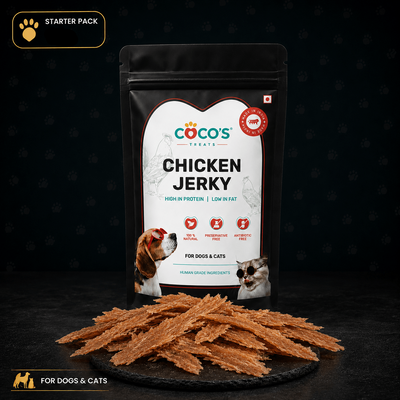
Take COCO's plain chicken jerky as an example. The full ingredient list:
Chicken, Turmeric, Cinnamon.
Three ingredients. No preservatives, no oils, no flavourings, no glycerine. The guaranteed analysis shows protein at 65%+ and moisture under 12% — concentrated real chicken, not water and filler.
The bottom line
Spending two extra minutes reading the back of a pack will save you from feeding your pet things you'd never eat yourself. Brands that are confident in their product print the ingredient list in clear, readable letters and keep the list short. Everyone else hides it.
FAQs — How to Read a Pet Food Label
Q: What does "human-grade" mean on a pet food label in India?
In India, "human-grade" is currently an unregulated marketing term — any brand can use it. The honest interpretation is that the ingredients meet the quality standards required for human consumption. To verify it, check that the ingredient list names real, recognisable food items (e.g., "chicken," not "poultry by-product meal") and that the manufacturer provides sourcing details.
Q: Is "meat meal" bad in pet food?
Not necessarily. "Chicken meal" is concentrated, dried chicken protein — it actually has a higher protein density than raw chicken by weight. The problem is "meat meal" or "animal meal" with no species named. Named meals (chicken meal, lamb meal) are acceptable; unnamed meals are a red flag.
Q: How do I know if a pet treat has too many preservatives?
Check for: BHA, BHT, ethoxyquin, and propylene glycol. A treat preserved naturally — or not at all, like air-dried jerky — won't need them. If you see any of those four in the ingredient list, that's your answer.
Q: What is the guaranteed analysis on a pet food label?
A mandatory table showing minimum % crude protein and crude fat, and maximum % crude fibre and moisture. For treats, prioritise high protein (30%+) and low moisture (under 15%) as indicators of quality.